Ready-to-review drafts, done before lunch
From demands and complaints to briefs, motions, and whatever's due next, Eve drafts in your voice, grounded in the case file.
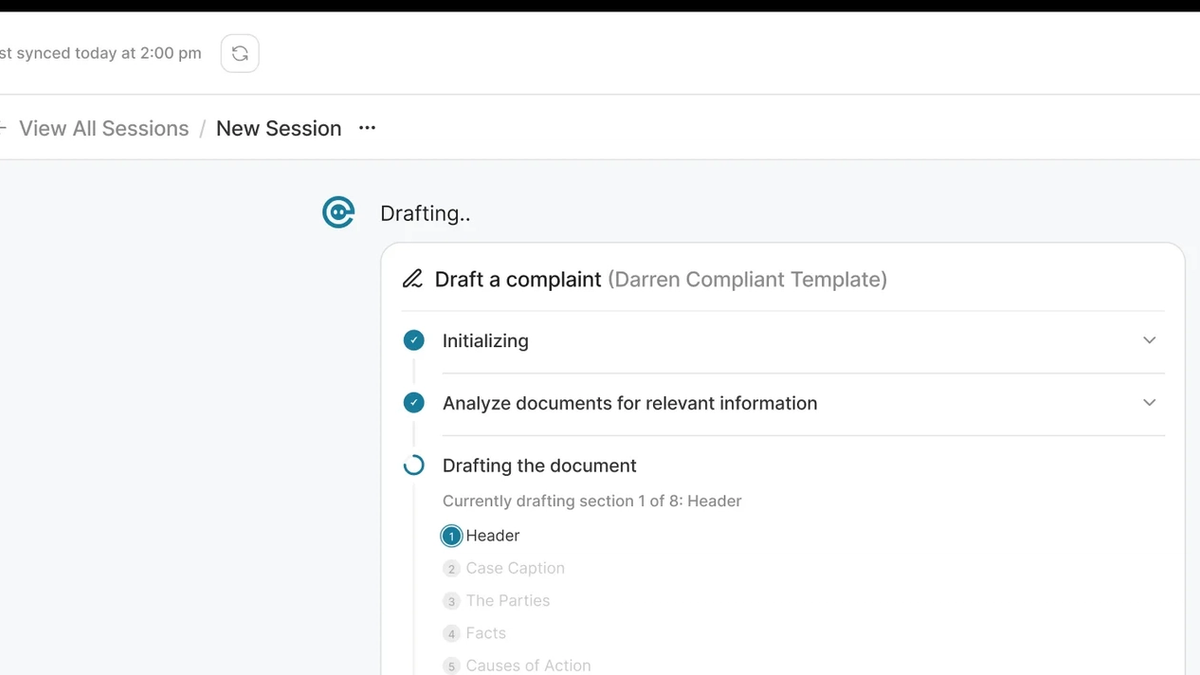
From demands and complaints to briefs, motions, and whatever's due next, Eve drafts in your voice, grounded in the case file.











Eve learns from your work, not a generic template. Your demand letters, motions, and other documents come back already matching your tone, structure, style, and formatting.
Demand letters that took hours come back in minutes (or overnight). Clear the backlog instead of adding to it, and get that time back for the work that actually needs you.
Eve drafts from the case file, with every claim tracing back to a source document. Review, confirm with one click, and send with confidence.
You get documents in the style, formatting, and any letterhead required.
Case-specific, not a simple template fill-in
Every cause of action, notice of intent, bad faith letter, or charge
Motions to compel, summary judgment oppositions, and mediation briefs
Deposition and direct examination outlines, juror charts, and exhibit lists
Letters of representation, meet-and-confer letters, and everything between
Set a trigger or schedule. Walk in to drafts waiting for your review.
Share your best completed documents. Eve studies your tone, structure, and letterhead.
Build your drafting agent for each document type or type and voice. Name it whatever fits your workflow (e.g., "MVA Demand," "Employment Complaint").
Eve pulls from the full case file and drafts in minutes. Set a scheduled run or a trigger to run the moment new documents arrive.
Highlight any passage to see the source documents and exact quotes Eve used, then make edits without leaving the platform.
Your letterhead, formatting, and structure carry through. Review, sign, and send when you’re ready.
2-3 hours
3-10 minutes
5 hours - days
1 hour
Days
5-10 minutes
2-3 hours
10 minutes
2 days
1 hour
2-3 hours
3-10 minutes
5 hours - days
1 hour
Days
5-10 minutes
2-3 hours
10 minutes
2 days
1 hour
“Eve is a foundation stone for all of our products. So whether that's demand letters, complaints, or discovery, everything we do starts at Eve from a work product perspective.”

“Eve has transformed our document production — from demand letters to discovery documents — enhancing our case strength and winning potential.”

“Eve helps our firm prepare high-quality comprehensive legal documents 4x faster than before. Our team can finalize with minimal time and effort to help us move cases along exponentially faster.”

“The drudgery of handling written discovery is now minimal. Eve handles all the difficult and boring work. I am free to think about the big picture and make the important and persuasive arguments. But I want to keep it a secret because now I have a leg up on the competition.”

“When I saw a complaint that Eve drafted, I wanted to jump all over it. What stood out to me overwhelmingly was the accuracy. Eve took the actual data that we had and used that information accurately.”

Anything you have examples of. Beyond demand letters, firms use Eve to draft complaints, discovery responses and requests, motions, mediation briefs, meet and confer letters, letters of representation, bad faith letters, deposition outlines, expert designations, settlement agreements, and more. If you can provide two completed examples, Eve can learn to draft that document type in your style.
You upload two of your best completed documents — not blank templates, but actual finished work product — and Eve analyzes your tone, structure, formatting, letterhead, and even the specific language you use to describe things like injuries or objections. From that point on, every draft it generates for that document type mirrors how your firm actually writes. You can create separate agents per attorney, case type, or jurisdiction.
With Eve, you can expect a draft that's roughly 80–90% complete. You'll review for accuracy, fill in any details Eve flagged with brackets, and make adjustments to tone or emphasis — all inside the platform using inline editing. You can highlight a section and tell Eve to "make this more concise" or "emphasize pain and suffering" without leaving the tool. It's a strong first draft, not a final filing.
Eve is a closed system. It only pulls from the documents you upload and your Central Library, never from the open internet. It will not fabricate case citations. If your document requires case law, you upload the relevant authorities to your Central Library and Eve references them.
Yes. You upload opposing counsel's discovery requests and select the case files Eve should pull from to draft responses. Eve learns your objection language and style from your sample responses, so it applies objections the way your firm actually writes them — not generic boilerplate. It handles interrogatories, RFPs, and RFAs, and you can create separate agents for each if your formatting differs across discovery types.
Eve handles a wide range of complexity. Complaints, discovery, mediation briefs, and motions to compel all produce strong results. For highly complex documents like summary judgment oppositions or documents requiring extensive legal argument, expect to do more editing — the factual foundation and structure will be solid, but the legal reasoning may need refinement.
Join 1500+ plaintiff firms starting their drafts closer to the finish line